
Temple of Golden Ether
A Contemplative House for Dharma, Healing, and Deep Listening
Temple of Golden Ether
A Living Sanctuary of the Divine Mother
Sacred Wisdom · Embodied Healing · Contemplative Inquiry · Oracular Remembrance
Hrīm Hrīm Hrīm. Jai Śrī Mā!
There is a stillness beneath the movement of the world.
A luminous spaciousness that does not stand apart from life, but holds its unfolding.
Within the breath.
Within the body.
Within the turning of seasons.
Within the mysteries of time, relationship, loss, renewal, and becoming.
Here, we call this sacred spaciousness Svarṇākāśa — the Golden Ether.
Welcome to the Temple of Svarṇākāśa, a living contemplative sanctuary devoted to the Divine Mother, the wisdom of embodied existence, and the sacred art of remembrance.
A place where ancient traditions and contemporary inquiry meet without losing their distinct voices.
Where the healing arts are rooted in reverence.
Where scholarship becomes an act of careful listening.
Where contemplation is not an escape from the world, but a way of entering into deeper relationship with it.
And where the mystery of the sacred is welcomed into the ordinary movements of human life.
You are welcome here.


Oracular Dharma
The Living Philosophy of the Temple of Golden Ether
What is Oracular Dharma?
Oracular Dharma is the practice of listening deeply to life.
It is rooted in the understanding that human beings exist within a living and participatory cosmos—one in which meaning, relationship, intuition, embodiment, symbol, and mystery are not separate from reality, but expressions of it.
Within the Temple of Golden Ether, Oracular Dharma refers not to fortune telling or certainty about the future, but to the cultivation of discernment.
It is the art of listening for what life is asking of us.
It is the practice of becoming available to wisdom.
It is the recognition that insight may arrive through contemplation, dreams, intuition, relationships, sacred texts, embodied experience, nature, ritual, silence, and the unexpected events of ordinary life.
-
The Temple begins with a simple premise:
Reality is alive.
The world is not merely a collection of objects.
It is a field of relationships.
The ancients spoke of this reality in many ways.
Some called it Spirit.
Some called it Brahman.
Some called it the Tao.
Some called it the Divine.
Within the language of the Temple, we often speak of Source, Consciousness, Śakti, Devī, or the Living Field.
No single word is sufficient.
The names matter less than the relationship.
-
The Temple of Golden Ether is deeply informed by contemplative traditions that honor the sacred feminine dimensions of reality.
Śakti may be understood as the dynamic creative intelligence that animates existence.
Devī represents the countless ways this intelligence expresses itself through creation, transformation, dissolution, wisdom, compassion, beauty, and mystery.
The Temple does not require any particular theological belief.
Rather, these teachings are offered as contemplative frameworks through which participants may explore their own relationship with the sacred.
-
Historically, oracles have existed in many cultures.
Their forms have varied, but their function has often been similar:
to listen.
Within the Temple, an oracle is not understood as someone who possesses absolute truth or special authority over others.
An oracle is a practitioner of deep listening.
Someone who cultivates attentiveness to symbol, intuition, relationship, embodiment, dreams, and the subtle dimensions of experience.
The purpose of oracular work is not to tell people what to do.
The purpose is to support greater awareness, reflection, discernment, and alignment.
-
Modern culture often seeks certainty.
Oracular Dharma values discernment.
Certainty attempts to eliminate mystery.
Discernment learns how to move wisely within it.
The Temple does not claim to possess final answers about reality.
Instead, we cultivate practices that help us listen more carefully, relate more consciously, and participate more skillfully in the unfolding of life.
-
The Temple draws upon many streams of contemplative practice, including:
Yoga
Meditation
Yoga Nidrā
Mantra
Jyotiṣa
Dream reflection
Symbolic inquiry
Ritual
Contemplative writing
Dharāṇā (focused attention)
Embodied awareness
Intuitive listening
These practices are not ends in themselves.
They are ways of cultivating relationship.
-
Many people arrive at the Temple while standing at a threshold.
A relationship is changing.
A vocation is emerging.
A loss has occurred.
A spiritual awakening has begun.
An old identity no longer fits.
Oracular Dharma recognizes these moments as sacred.
Not because they are easy.
But because they invite us into deeper participation with life.
The Temple exists to accompany people through such thresholds with compassion, humility, and care.
-
At its heart, the Temple of Golden Ether is devoted to a simple practice:
To listen.
To listen to the body.
To listen to the soul.
To listen to one another.
To listen to the rhythms of nature.
To listen to the wisdom traditions.
To listen for Dharma.
To listen for the quiet voice beneath the noise.
And from that listening, to participate more consciously in the mystery of being alive.

The Golden Ether
The Sacred Field of Remembrance
Svarṇa — golden.
Ākāśa — space, ether, the subtle expanse.
Within the devotional life of this Temple, Svarṇākāśa names a living expression of the Divine Mother and the luminous field through which presence, relationship, and remembrance may be contemplated.
She is encountered as spaciousness and intimacy.
As the golden radiance of awareness.
As the capacity to hold what appears divided without demanding that its differences disappear.
Body and spirit.
Ancestry and becoming.
Stillness and movement.
Knowledge and mystery.
The personal and the collective.
The Golden Ether invites a return to relationship—not by escaping the complexity of life, but by discovering a deeper coherence within it.
This is the heart of the Temple's contemplative orientation:
Coherence does not require sameness.
Here, the sacred is not understood as something distant from the world.
It may be encountered in the body, in the land, in acts of care, in the discipline of study, in the practice of devotion, and in the quiet courage of living truthfully.
Svarṇākāśa is the contemporary devotional name through which this Temple honors that mystery, in living relationship with the Divine Mother and the wisdom currents of Śākta tradition.
-
Practice. Study. Healing. Remembrance.
The Temple of Golden Ether is a living house of contemplative practice, sacred inquiry, healing arts, and shared learning.
Its foundations are nourished by the traditions of Yoga, Śākta Tantra, contemplative philosophy, Ayurveda, and Jyotiṣa, alongside serious engagement with Disability Studies, Religious Studies, and the ethical questions of contemporary life.
These streams do not become one undifferentiated teaching.
Each carries its own history, discipline, methods, and responsibilities.
Yet their encounter can deepen our capacity to listen, discern, and respond.
The Temple welcomes the seeker, the practitioner, the scholar, the artist, the person in transition, and the one who simply longs for a quieter relationship with life.
You need not arrive with certainty.
You need not share a particular spiritual identity.
You are invited to encounter the work with curiosity, freedom, and care.
The Temple is a place to remember, to inquire, to practice, and to become more fully present to the life we are living.
-
Sacred Practice & the Wisdom of Śakti
At the devotional heart of the Temple is the Divine Mother—Parāśakti—and the living wisdom of Śākta contemplative traditions.
Through the philosophical and symbolic currents of the Mahāvidyās, the disciplines of Yoga, mantra, meditation, ritual, and embodied inquiry, we explore the sacred as a presence within and beyond the changing forms of life.
The Temple honors both the depth of traditional transmission and the unfolding nature of contemporary devotional expression.
Here, spiritual practice is not a performance of transcendence.
It is an invitation into relationship, discernment, responsibility, and remembrance.
The Healing Arts & The Nidra Nest
Slow. Down. Here.
The healing arts offer an embodied doorway into the Temple's contemplative world.
Through Individual Yoga Therapy, Yoga Nidrā, sacred sound, restorative practice, and intimate gatherings, we cultivate spaces where the body may be received with patience and reverence.
The Nidra Nest is the Temple's emerging sanctuary for sacred rest and embodied healing.
A place to soften the pace, listen more deeply, and explore the relationship between presence, care, and the living body.
Healing here is not understood as a demand to become someone other than who you are.
It begins with honoring the reality of your experience and discovering what kinds of practice and support may nourish your life.
Threshold Guidance & Oracular Listening
There are moments when life asks us to listen differently.
At the crossroads of vocation, relationship, identity, grief, spiritual awakening, and change, the Temple offers contemplative accompaniment through Intuitive Dharmic Counseling and Threshold Guidance.
Through Oracular Sessions, we enter a focused space of symbolic inquiry, intuitive reflection, and sacred listening.
These are distinct offerings, united by respect for personal agency and the art of discernment.
The Oracle does not claim ownership of another person's truth.
The work is to make room for insight without manufacturing certainty.
The Oracle offers a mirror. The person remains the author of their life.
Inquiries & Scholarship
The Temple is also a house of learning.
Its intellectual life moves through Disability Studies, Religious Studies, Yoga Therapy, Tantra, Ayurveda, Jyotiṣa, and embodied philosophy.
Here, scholarship and contemplative practice are allowed to converse while retaining their different standards of knowledge.
We explore questions of embodiment, consciousness, disability, care, labor, time, ritual, institutional life, and the possibilities of human flourishing.
Study is not merely preparation for teaching.
It is a joy, a discipline, and a way of cultivating greater responsibility toward the world.
Prairie Dharma & Place-Rooted Practice
The Temple's contemplative life is also shaped by the prairies of Iowa and the wider relationships of land, ecology, community, labor, and history.
Prairie Dharma asks what it means to live sacred wisdom here, in this place and time.
It is an inquiry into the meeting of contemplative practice and the responsibilities of everyday life.
The emerging Prairie Oracle gives expression to a related art of listening and interpretation:
KĀLA — What time is this?
ŚAKTI — What power is moving?
DHARMA — What relationship or response is called for?
Receive.
Differentiate.
Discern.
Respond.
This is a contemporary, place-rooted contemplative practice, undertaken with respect for the histories, living communities, and Indigenous sovereignty of the lands we inhabit.
-
A Sanctuary Beyond the Session
The Temple is more than a collection of individual offerings.
It is an evolving world of sacred writing, symbolic cosmology, contemplative resources, and shared inquiry.
Within its Akāśic Living Library, teachings, essays, reflections, and philosophical explorations are gathered as part of an ongoing conversation.
Through the Temple's contemplative and creative expressions—including the Golden Ether Mirror, Akāśic Sanctuary, Akāśa FM, and other spaces of reflection and gathering—we explore different ways of listening, learning, and participating in sacred life.
These expressions are not all required to serve the same purpose.
Some invite study.
Some invite rest.
Some offer symbolic reflection.
Some support practice, creativity, or community.
Together, they form a living house whose rooms may be entered according to the needs and interests of each visitor.
The Temple is not a demand to do more. It is an invitation to enter more deeply.
-
Meet the Steward of the Temple
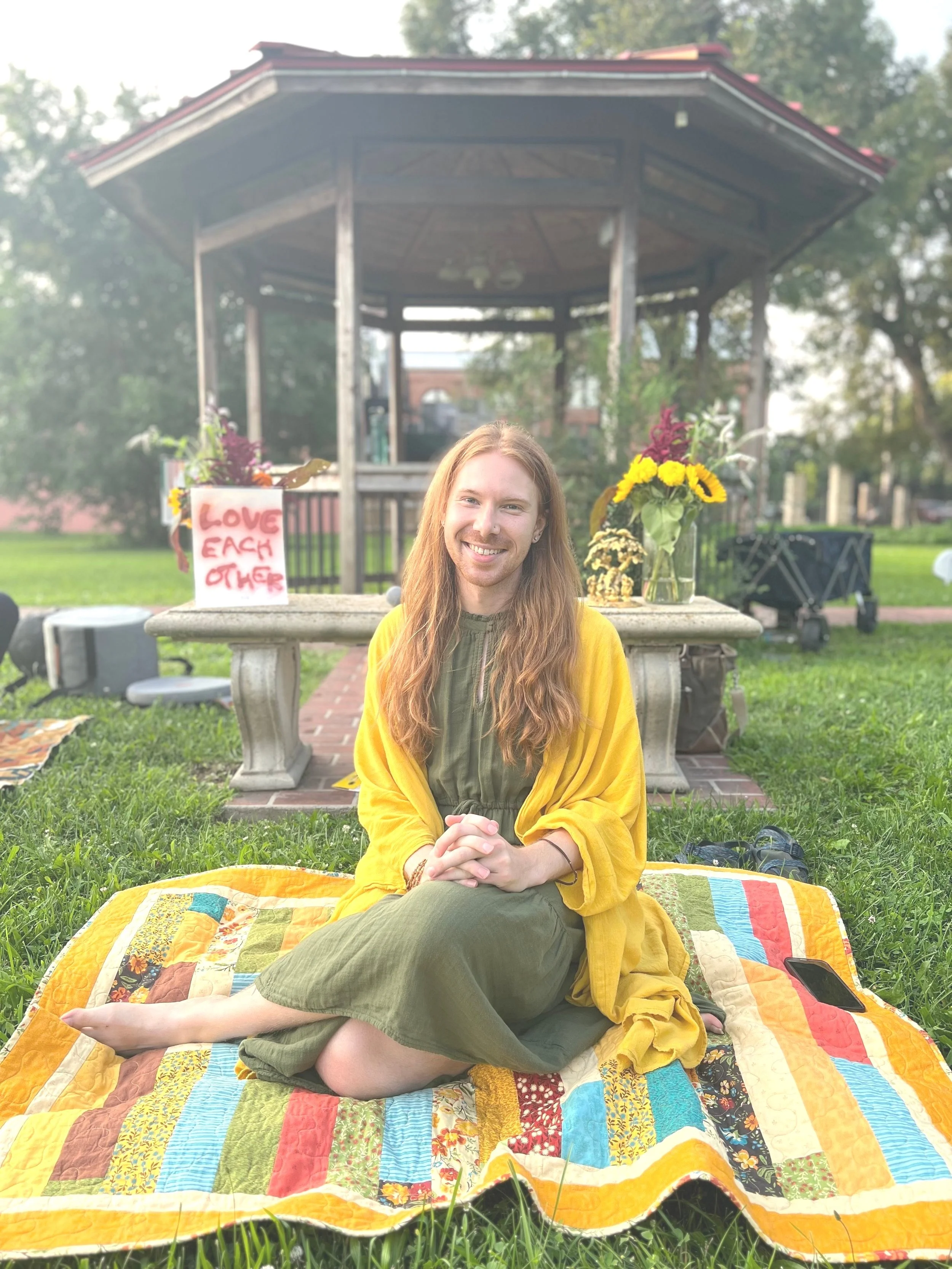
Oracle Zaria
The Temple of Svarṇākāśa is founded and tended by Oracle Zaria, a Certified Yoga Therapist (C-IAYT), RYT-500 Yoga teacher, contemplative guide, healing arts practitioner, and student of Disability Studies, Jyotiṣa, Ayurveda, and Śākta traditions.
Zaria's work emerges from years of engagement with Yoga, disability services, contemplative practice, philosophical inquiry, and the questions of care and human flourishing.
Through individual offerings, writing, scholarship, and the evolving life of the Temple, Zaria cultivates spaces for sacred listening, embodied practice, and thoughtful participation in the world.
The Temple is both a devotional offering and a living expression of this ongoing formation.

A Blessing for the Threshold
May this be a place where the hurried may remember stillness.
Where the weary may encounter rest.
Where the questioning may find room to inquire.
Where the body is met with dignity.
Where knowledge is cultivated with humility.
Where devotion opens the heart without closing the mind.
Where the sacred is not removed from the world, but encountered more deeply within it.
May the Golden Ether remind us that what is fragmented need not remain without relationship.
That what is changing need not be without meaning.
That what is mysterious need not be forced into certainty.
And that each life may discover its own way of participating in the great unfolding.
Welcome to the Temple of Svarṇākāśa.
Welcome to the Temple of Golden Ether.
Hrīm Hrīm Hrīm.
Jai Śrī Mā.
THE ORACLE LEADS. THE MIRROR REFLECTS. THE TEMPLE REMEMBERS.
Temple of Svarṇākāśa — Temple of Golden Ether
A living house of devotion, healing arts, scholarship, and sacred remembrance.
Book an Appointment
Frequently Asked Questions
Do I need prior experience with yoga or meditation?
Not at all. All experience levels are welcome.
Are these offerings religious?
The Temple draws inspiration from Yoga, Dharma traditions, Jyotiṣa, and contemplative wisdom streams. Participation does not require adherence to any particular religious belief.
What is Oracular Dharma?
Oracular Dharma is the practice of listening deeply to the symbolic, intuitive, contemplative, and relational dimensions of life. It is not fortune telling or prediction.
What is a Threshold Guidance Session?
A one-on-one contemplative session designed to support discernment, life transitions, spiritual inquiry, and personal growth.
Do you predict the future?
No.
The purpose of these offerings is not prediction but reflection, discernment, and conscious participation in life.
Are these services therapy?
No.
While Yoga Therapy is informed by therapeutic principles, Temple offerings are not psychotherapy, counseling, crisis services, or medical treatment.